

Australia and the European Union concluded negotiations on a historic free trade agreement on 24 March 2026, following eight years of extensive negotiations. One of the key obstacles to the signing of the Australian and European Union Free Trade Agreement (AEUFTA) was the European Union’s insistence that Australia provide geographical indication (GI) protection to the names of agricultural products and spirits that have been recognised domestically.
The compromise position reached allows Australian producers to continue to use some names that have been used as common descriptive names locally for generations, such as parmesan and kransky. The terms of the AEUFTA also significantly allows winemakers to continue to use the term prosecco domestically. A limited number of other GI names, such as feta, romana, gruyere and ouzo, are subject to grandfathering and lengthy phase-out periods under the terms of the AEUFTA. Now that the AEUFTA has been signed, there is a strong incentive for Australia to adopt a formal expanded framework for the protection of GIs which extends beyond wines and grape products and provides stronger safeguards for other products, particularly agricultural products and spirits.
The objectives of GI protection, namely to protect the connection between a geographical area and characteristics of a product that are essentially attributable to its connection with that geographical area, are more likely to be achieved by introducing a dedicated GI framework rather than relying on alternative mechanisms which are not specifically designed to achieve this objective.
Background to the AEUFTA Negotiations
Negotiations relating to the AEUFTA faced persistent obstacles since they commenced in 2018, primarily relating to EU market access for Australian agricultural products, such as beef and dairy, and the EU requirement that its EU GIs be protected in Australia.
As part of the AEUFTA negotiations, the EU asked Australia to protect 236 spirit names and 172 agricultural and other foodstuff names as GIs in Australia[2]. The EU requested that these GI names be protected against:
2. any misuse, imitation or evocation, even if the true origin of the product is indicated;
3. any other false or misleading indication as to the origin, nature or essential qualities of the product; and
4. any other practice liable to mislead the consumer as to the true origin of the product.
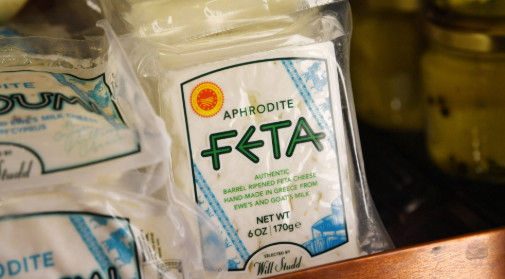
One of the most prominent controversial names that the EU sought GI protection for that Australian producers resisted was ‘feta’ cheese. Many Australia cheesemakers use the term ‘feta’ generically to describe a type of salty white cheese, however if the initial EU proposal was accepted they would be prevented from not only using the term ‘feta’, but also ‘feta-style’ or ‘feta-like’. The AEUFTA that was eventually signed includes grandfathering and lengthy phase-out periods for a limited number of terms such as feta, romana, gruyere and ouzo.
The AEUFTA negotiations required the Australian government to balance competing interests, such as the cost to Australian businesses if they were required to rebrand to remove use of EU GI product names, the risk of potential revenue loss due to resulting damage to brand recognition and the administrative costs associated with protecting European GIs in Australia on the one hand and the benefits for Australian businesses if the EU allowed Australian products greater access into the EU market on the other hand.
EU Expansion of GI Protection to Craft and Industrial Products
The EU has the most comprehensive internal framework for the protection of GIs and strongly advocates for the protection of EU GIs globally, primarily through bilateral free trade agreements. The EU recently extended the GI protection that already existed for agricultural products, wine and spirits to other categories of goods whose quality and reputation depend on geographical origin, such as craft and industrial goods,[4] and increased the level of protection afforded to agricultural and food GIs, including increasing the scope of GI protection where GIs are used as an ingredient in a processed product[5]. This illustrates its recognition of the value of GIs to preserve cultural traditions that are closely tied to geographical origin, enhance the economic benefits to local communities and increase the value of authentic EU regional products in global markets.[6]
Current mechanisms for Protecting GIs in Australia
In Australia, GIs are currently protected by two means[7]:
1. There is a dedicated regulatory wine GI framework for wine and grape products[8]; and
2. GIs for all other products are protected by trade mark laws[9], consumer protection laws[10] and passing off at common law.
Australian Wine GI Framework
The Australian Wine GI framework protects the use of GIs on wine labels by requiring that at least 85 per cent of grapes used to produce the product originate from the region or locality in Australia that comprises the GI[11]. Unlike the European “Appellation” system, the Australian wine GI framework primarily regulates the origin of grapes, rather than specific production methods or grape varieties.
GI Protection for Products other Than Wine and Grape Products
Certification trade marks, which are owned by certifying bodies, are used by authorised producers to indicate that their product has been certified by the certifying body in relation to quality or some other characteristic, including origin, material or mode of manufacture, and thereby distinguish the product from other products offered in the marketplace that are not certified[12]. The use of certification trade marks is governed by a set of rules[13], which must be approved by the Australian Competition and Consumer Commission (ACCC)[14]. Provided that the approved user complies with the rules, any trader may use a certification trade mark without the need to be affiliated with or connected to any particular association[15].
Giving Effect to Obligations Under AEUFTA
[2] Australian Government Department of Foreign Affairs and Trade ‘List of EU’s requested Geographical Indications’ 2020 (https://www.dfat.gov.au/trade/agreements/negotiations/aeufta/geographical-indications/list-of-eu-requested-geographic-indications-gis)
[3] Agreement between Australia and European Community on Trade in Wine 1994 and Australia – European Commission Agreement of Trade in Wine 2010.
[4] Regulation (EU) 2023/2411 of the European Parliament and of the Council of 18 October 2023 on the Protection of Geographical Indications for Craft and Industrial Products
[5] Regulation 2024/1143 of the European Parliament and of the Council of 13 May 2024.
[6] For a comprehensive discussion on this topic, see Paula Zito, ‘Crafting identity: lessons for Australia from the European Union’s geographical indications framework – crafting culture, anchored in place’, Oxford Journal of Intellectual Property Law & Practice, 2026, Vol 00, No. 00.
[7] Australia complies with its international obligation under the Trade Related Aspects of Intellectual Property Agreement 1994 (TRIPs Agreement) to provide GI protection by these means, with Article 22 of the TRIPS Agreement providing members with the discretion to determine the legal means appropriate to protect GIs within their country.
[8] The Australian wine GI framework is established pursuant to the Wine Australia Act 2013 (Cth), Wine Australia Regulations 2018 (Cth) and the Label Integrity Program and is regulated by Wine Australia.
[9] Trade mark laws provide GI protection by registration of certification or collective trade marks under the Trade Marks Act 1995 (Cth)
[10] Consumer protection laws are governed by the Australian Consumer Law as set out in Schedule 2 of the Competition and Consumer Act 2010 (Cth)
[11] Regulation 26 of Wine Australia Regulations 2018 (Cth),
[12] Part 16, Section 169 of the Trade Marks Act 1995 (Cth)
[13] Section 173 of the Trade Marks Act 1995 (Cth)
[14] Section 175 of the Trade Marks Act 1995 (Cth)
[15] Section 172 of the Trade Marks Act 1995 (Cth)
[16] Section 162 of the Trade Marks Act 1995 (Cth)


